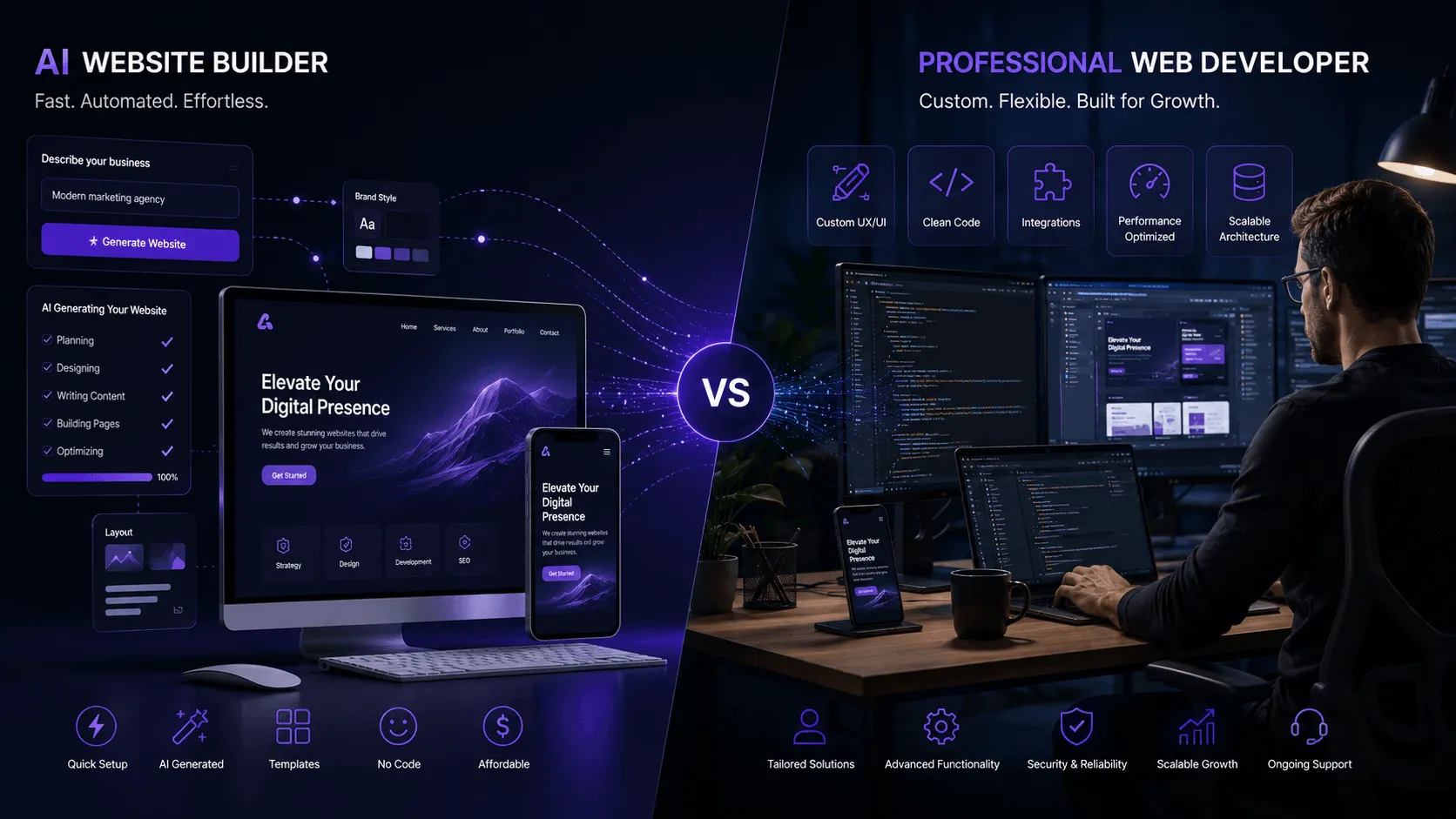
AI website creation is now a mainstream feature across major platforms. Wix offers conversational AI site creation, Squarespace offers Blueprint AI, and Webflow has expanded AI-assisted site building and development. The useful search angle is therefore no longer “Can AI build a website?” It can. The more valuable question is when is an AI website builder enough, and when does a business benefit from professional web development?
Quick Answer
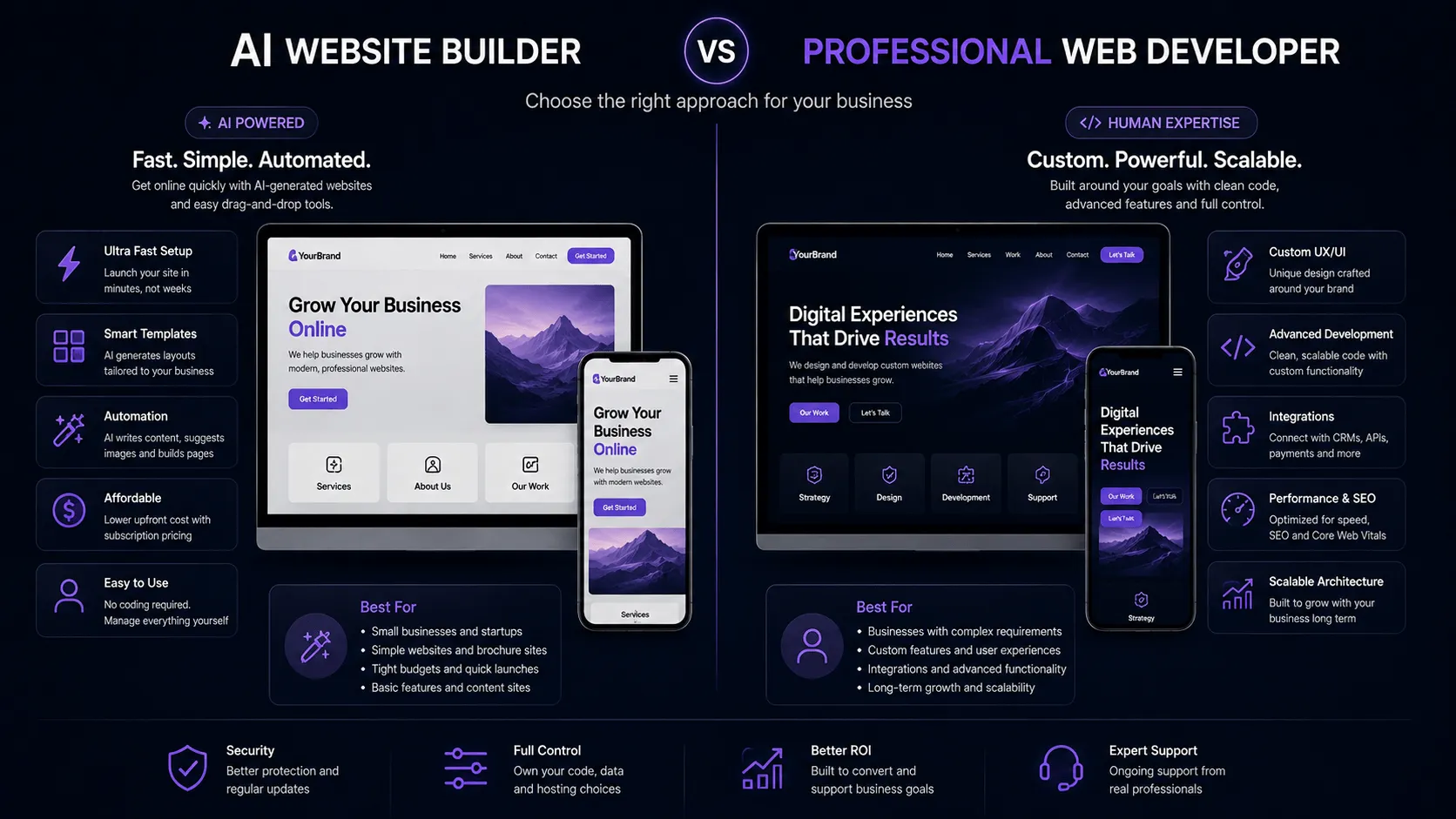
AI website builders are usually best for simple websites where speed, affordability and ease of setup are the priorities. Professional web developers are better suited to businesses that need custom design, advanced functionality, integrations, performance optimisation or greater control. The right choice depends on what the website needs to achieve.
The rise of AI has dramatically lowered the barrier to creating a website. A business owner can describe a company, select preferences and generate pages, layouts and content in minutes. Website platforms are increasingly integrating AI into design, content creation and development workflows.
That creates an obvious question: Why hire a professional web developer if AI can build a website?
The answer depends on what you mean by “build.” If your goal is getting a straightforward website online quickly, an AI website builder can be an excellent option. If the website is expected to generate leads, integrate with business systems, support complex customer journeys, represent a distinctive brand or become a critical part of operations, the decision becomes more complicated.
What Is an AI Website Builder?
An AI website builder is a platform that uses artificial intelligence to automate parts of creating a website. Instead of manually designing every section, users can provide information about their business and allow the platform to generate a starting point.
Depending on the platform, AI may assist with:
- Page structures
- Layouts
- Website copy
- Images
- Colour and typography choices
- Sections
- SEO settings
- Product descriptions
- Code
- Content creation
Major website platforms now offer AI-assisted creation in different forms. Wix, for example, provides conversational website generation, while Squarespace’s Blueprint AI creates personalised site foundations from user input.
The biggest advantage is accessibility. You do not need to be a developer to produce a functional website. But automation and professional development solve different problems.
What Does a Professional Web Developer Do?
A professional web developer builds and implements websites and web applications according to specific requirements. That can include far more than writing code. Depending on the project and team, professional website development can involve:
- Requirements analysis
- Technical architecture
- Custom functionality
- CMS implementation
- Responsive development
- Database work
- API integrations
- eCommerce
- Performance optimisation
- Accessibility
- Security
- Analytics
- Testing
- Deployment
- Maintenance
In an agency environment, development may also work alongside UX designers, UI designers, copywriters, SEO specialists and strategists. This means you are not simply paying someone to perform tasks that an AI tool could potentially automate. You are paying for decisions, implementation and accountability around a particular business problem.
AI Builder vs Developer: Quick Comparison
| Factor | AI Website Builder | Professional Web Developer |
|---|---|---|
| Initial cost | Usually lower | Usually higher |
| Launch speed | Very fast | Depends on scope |
| Technical knowledge required | Low | Handled professionally |
| Custom design | Limited to platform | Potentially extensive |
| Custom functionality | Limited/moderate | Extensive |
| Complex integrations | May be limited | Can be custom-built |
| Scalability | Platform-dependent | Architected for growth |
| SEO control | Sufficient for basics | Deeper technical control |
| Performance control | Platform-dependent | Greater implementation control |
| Maintenance | Often simplified | Depends on solution |
| Ownership/portability | Platform-dependent | Depends on tech and contract |
| Best suited to | Simple sites, rapid launches | Business-critical/custom |
Neither column is automatically better. The important question is which trade-offs fit the business.
1. Cost: AI Website Builders Usually Win Initially
For businesses with small budgets, AI website builders have an obvious advantage. The initial cost can be dramatically lower than commissioning a custom website. Many platforms operate through monthly or annual subscriptions. A business owner can generate the initial website and manage it without paying separately for design and development.
That can make sense for new businesses, side projects, personal websites, event websites, simple portfolios and early-stage ideas.
Professional development requires a larger upfront investment because people spend time understanding, designing, building and testing the solution. However, initial cost is only one part of the calculation. Businesses should also consider subscription fees, premium applications, transaction fees, future redevelopment and whether the platform can accommodate changing requirements. The cheapest starting option is not necessarily the lowest total cost of ownership.
2. Speed: AI Builders Can Be Extremely Fast
AI excels at creating a starting point quickly. A simple website can move from an idea to a working draft in a very short period. Professional projects take longer because they can involve discovery, planning, content, UX, design, development and testing.
For a temporary campaign or a business that simply needs a credible online presence quickly, the speed advantage of an AI website builder can be valuable. But speed should be evaluated against the objective. Launching in one day is impressive only if the website does what the business needs. A rushed website that requires replacement six months later may not have saved much time.
3. Design and Branding: Customisation Changes the Equation
AI website builders can create attractive layouts, substantially better than the crude DIY tools businesses may remember from earlier generations. However, creating an attractive website and creating a distinctive brand experience are different tasks.
AI systems generate from existing patterns and the information provided to them. Platform templates and component systems also create boundaries around what can be designed. Professional custom design can begin with the brand itself. Designers can consider customer expectations, competitive positioning, visual identity, content hierarchy, user journeys, conversion objectives, responsive behaviour, interactions and accessibility.
For a small business that simply needs a polished online presence, AI-generated design may be sufficient. For a company whose website plays an important role in brand differentiation, custom design can provide more strategic control.
4. Functionality: Developers Win When Requirements Become Complex
AI website builders are increasingly capable. They can support forms, blogs, online stores, booking functionality and integrations through their platform ecosystems. Problems appear when requirements become highly specific.
Suppose a South African business needs a quotation system that collects customer requirements, calculates pricing according to custom rules, creates a branded quotation, sends information to a CRM, creates an internal task, notifies the correct salesperson and tracks the lead through analytics. A platform may support parts of that workflow. A professional developer can design the solution around the workflow itself. This distinction becomes important for websites that connect deeply with business operations.
5. SEO: Neither Option Automatically Ranks Better
A common misconception is that a custom website automatically ranks better than a website builder. That is not how search works. Major website platforms provide many basic SEO capabilities, including editable metadata, structured page hierarchies, redirects and other search settings. Professional developers also cannot guarantee rankings.
Search visibility depends on many factors, including content quality, search intent, site architecture, internal linking, authority, technical implementation and competition. The difference is primarily control. Professional development can provide greater flexibility when a website requires specialised technical SEO, complex structured data, programmatic content, unusual architecture or detailed performance work. For a five-page local business website, those capabilities may not be necessary.
6. Performance: Implementation Matters More Than Labels
“Custom built” does not automatically mean fast. A poorly developed custom website can be slower than a well-optimised website-builder site. Likewise, using an AI builder does not guarantee good performance.
Performance can be influenced by images, video, fonts, JavaScript, third-party applications, tracking scripts, hosting, rendering, caching and code quality. The advantage of custom development is that developers may have greater control over these variables. The disadvantage is that poor technical decisions can still create poor results. Businesses should evaluate actual performance practices rather than assuming a technology automatically makes a site fast.
7. Scalability: Think About Tomorrow’s Requirements
A website that meets today’s needs may not meet tomorrow’s. Imagine a company initially needs a five-page informational website. Twelve months later, online bookings. Then customer accounts and CRM integration. Eventually, a custom customer portal.
The original AI website builder might handle all of these requirements. Or it might not. This is why businesses should think beyond launch. Professional developers can select architecture according to expected growth and create custom functionality when standard platform capabilities are insufficient. That does not mean every startup should pay for enterprise architecture from day one. It means the expected direction of the business should influence the initial technology choice.
8. Ownership and Portability: Read the Platform Rules
Ownership is often overlooked when comparing a website builder vs web developer. With hosted website builders, the website operates within the provider’s platform and terms. Moving the exact site to another system may not always be straightforward. Custom development varies. A WordPress website, for example, can generally be hosted with different providers, although premium plugins, licences and custom infrastructure may affect migration.
Businesses should establish who owns the design, who owns custom code, who controls the domain, whether content can be exported, whether the website can move to another host, what happens if the subscription ends and whether third-party licences are transferable. These questions matter whether you choose AI, an agency or a freelancer.
When Should You Use an AI Website Builder?
An AI website builder can be a sensible choice when your requirements are simple, your budget is limited, you need to launch quickly, the website is not business-critical, you are testing an idea, you are comfortable managing the site yourself, standard functionality meets your requirements and custom integrations are unnecessary.
For an early-stage business, this can be the correct commercial decision. There is little value in spending R50,000 on a custom digital platform if the company has not yet established whether customers want its product. Use the appropriate tool for the stage of the business.
When Should You Hire a Professional Web Developer?
Professional web development becomes more valuable when the website needs to do more than establish an online presence. Consider professional development when the website is central to lead generation, brand differentiation matters, you require custom functionality, complex integrations are necessary, the website processes meaningful revenue, performance is commercially important, you need specific technical SEO capabilities, the site must support unusual customer journeys, you expect substantial growth or the website connects with internal business systems.
Professional development can also reduce the burden on internal teams. A business owner may technically be capable of building a website with AI but still decide that their time is better spent running the company. Explore our web development services and custom WordPress website design for context.
Hybrid Approach: AI + Professional Development
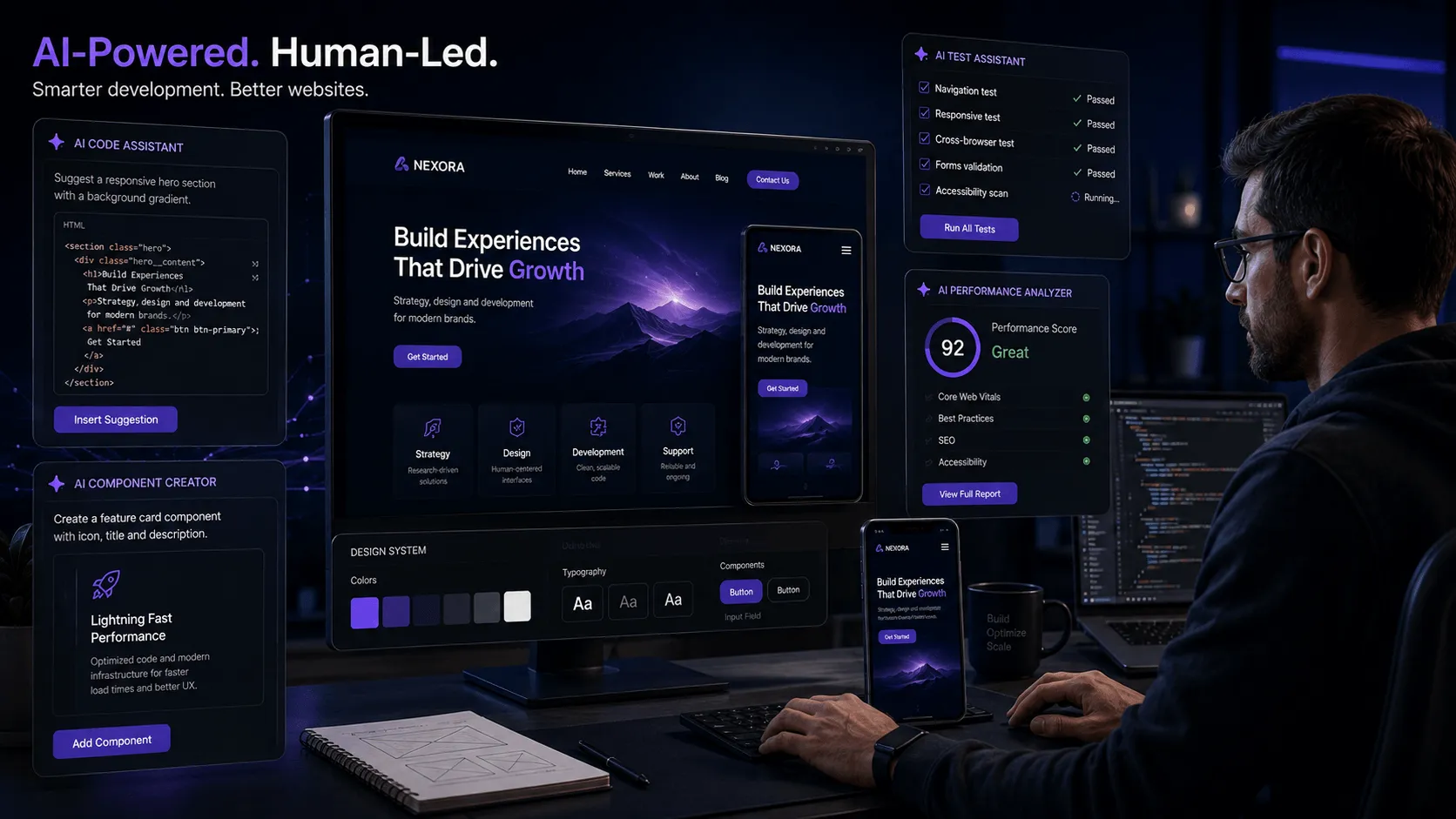
The most interesting option in 2026 may not be AI versus web developers at all. It may be AI with web developers. Professional developers increasingly use AI during their own workflows. AI can assist with repetitive code, research, debugging, testing, documentation and prototyping. Designers can use AI during exploration and content workflows. Businesses can use AI to help organise requirements and generate initial content.
Human professionals then provide strategy, judgement, customisation and quality control. This combination can potentially make professional web development more efficient without reducing every website to an automatically generated template. The future is therefore unlikely to be a simple battle between humans and website generators. It is more likely to involve professionals using AI as another tool in the development process.
Which Is Better for Your Business?
Choose based on the problem, not the technology. If you need a straightforward website quickly and affordably, an AI website builder may be the better choice. If your website needs to differentiate your brand, generate significant business, integrate with other systems or support custom workflows, professional development may justify the additional investment.
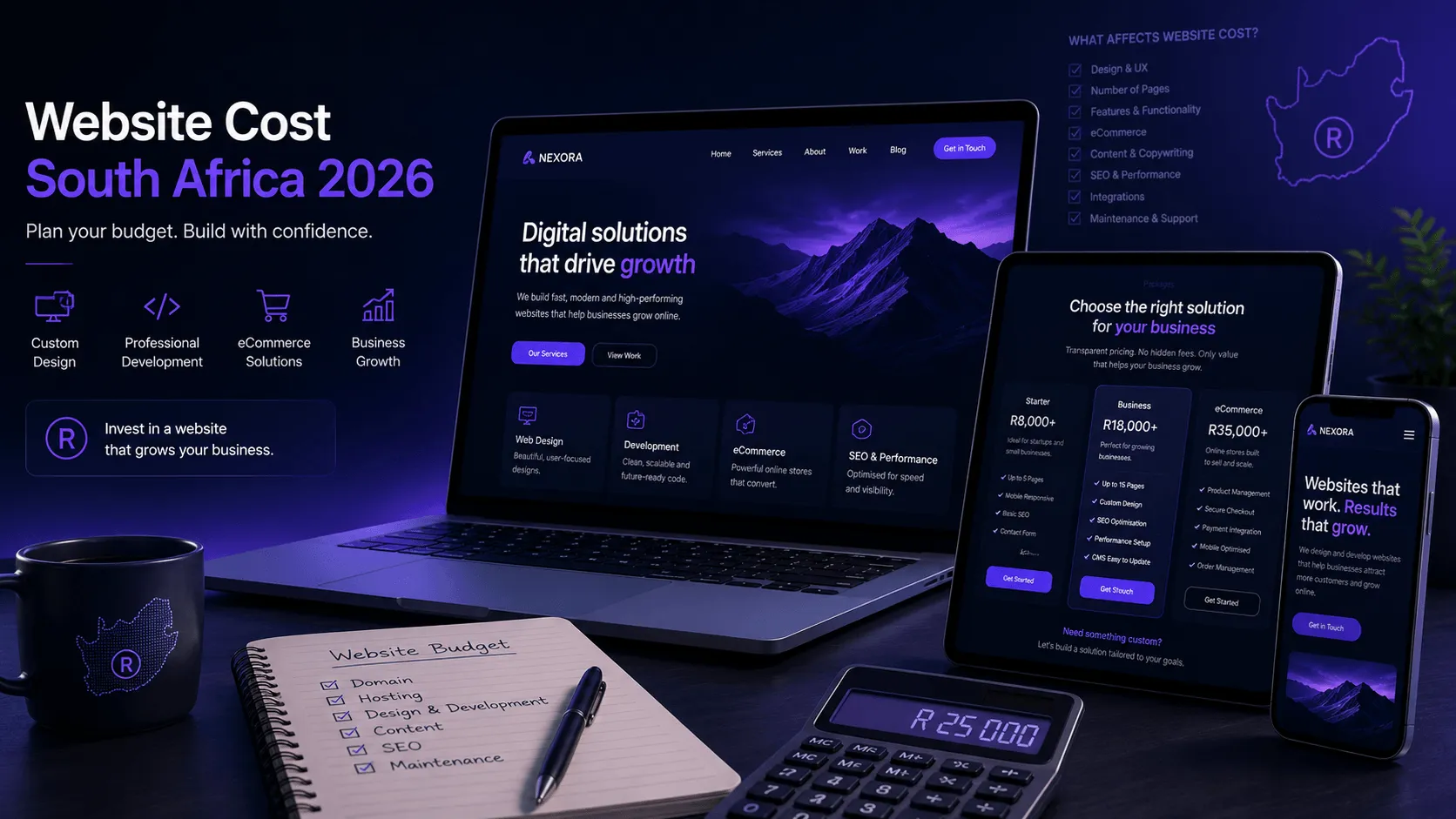
Ask yourself how important the website is to revenue, how distinctive the experience needs to be, whether you require custom functionality, which systems need to connect to it, how quickly you expect requirements to change, who will maintain the website and what happens if you outgrow the platform. The answers will usually make the decision clearer. For related reading, see our guide to website costs in South Africa in 2026 and web development trends in 2026.
Frequently Asked Questions
Can AI build a complete website?
Yes. Modern AI website builders can generate layouts, pages, text and other website elements from prompts or business information. The level of customisation and functionality available depends on the platform.
Are AI website builders good for small businesses?
They can be. AI website builders are particularly useful for small businesses that need a relatively simple website, have a limited budget and want to launch quickly without custom development.
Will AI replace web developers?
AI is automating parts of web development, but professional projects still require decisions around architecture, integrations, security, performance, accessibility, testing and business requirements. Developers are increasingly using AI as part of their workflow rather than simply competing against it.
Is an AI website builder good for SEO?
AI website builders can support SEO when the underlying platform provides appropriate controls and the website has useful content, sound architecture and good technical implementation. Using AI does not automatically improve or harm rankings.
Is a custom website better than an AI website?
Not necessarily. A custom website provides greater flexibility, but that flexibility has a cost. A simple business may receive better value from an AI builder, while organisations with complex requirements may benefit from custom development.
Can I move an AI-generated website to another platform?
It depends on the platform. Some systems allow content or code to be exported in certain ways, while others are closely tied to their hosted environment. Check portability and ownership terms before committing to a platform.
How much does a professional website cost in South Africa?
Pricing varies substantially according to design, functionality, content, eCommerce requirements and integrations. For detailed South African market ranges, see our guide to website costs in South Africa in 2026.
Should a startup use AI or hire a developer?
A startup with simple requirements may benefit from using an AI builder to validate its idea quickly. Professional development becomes more valuable when custom functionality, integrations, differentiation or scalability become important.
Sources
- Wix AI Website Builder — Wix
- Squarespace Blueprint AI — Squarespace
- Webflow AI — Webflow