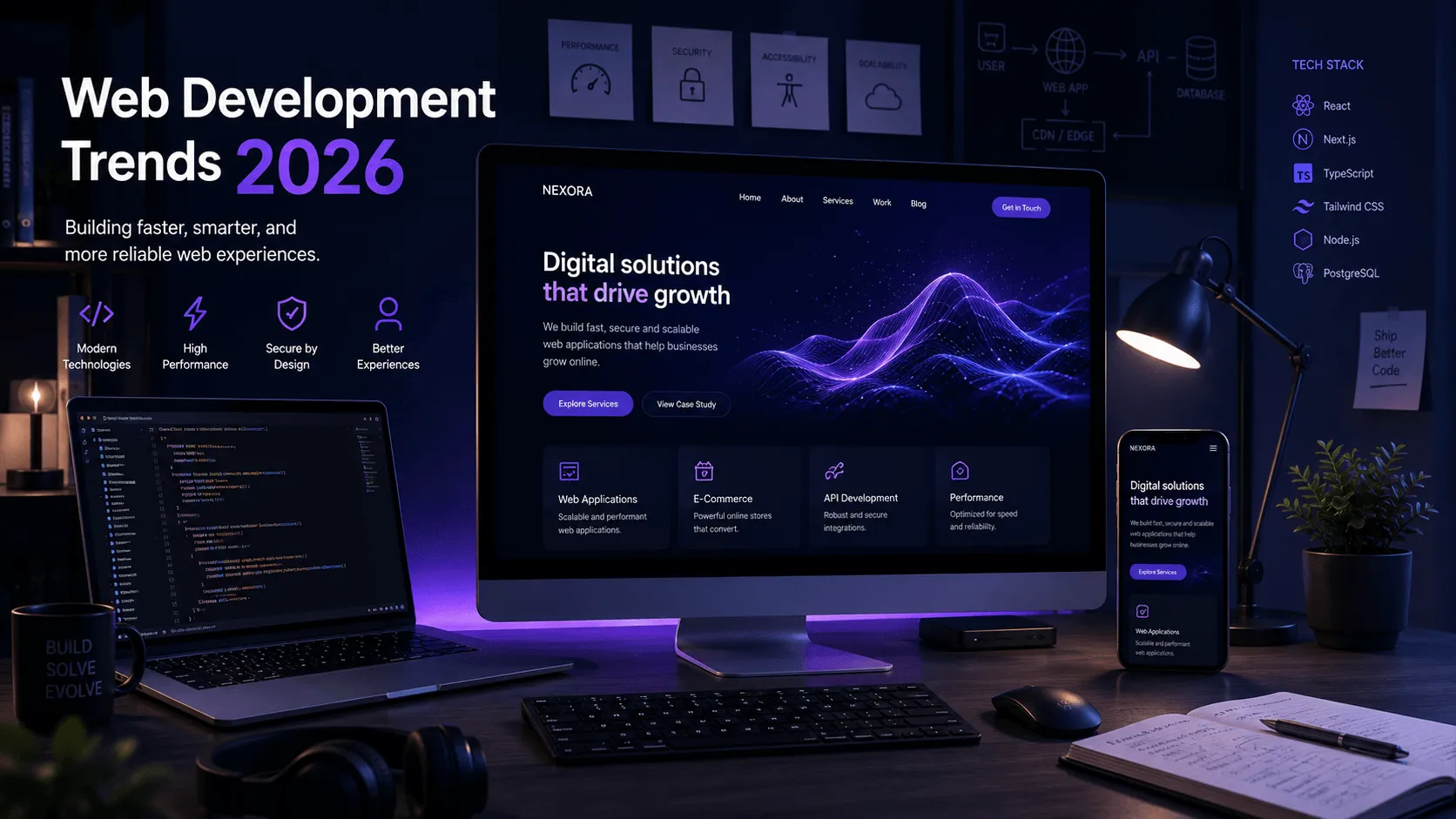
Web development trends in 2026 are being shaped by a simple expectation: websites and web applications need to become faster, smarter, safer and easier to use without becoming unnecessarily complicated.
Artificial intelligence is changing how developers write and test code. Server-first architectures are reconsidering how much work should happen in the browser. Edge computing is bringing processing closer to users, while advances in browser standards are reducing the need for complicated workarounds.
For businesses, however, the important question is not which technology is newest.
It is which technologies can create a faster website, better customer experience, more maintainable platform and stronger return on digital investment.
Here are 12 web development trends shaping the web in 2026.
How Web Development Is Changing in 2026
Web development has traditionally moved quickly, but AI has accelerated that pace considerably.
Developers can now use AI throughout parts of the development lifecycle. At the same time, browsers themselves have become significantly more capable.
The result is an interesting shift.
Developers can potentially build sophisticated experiences faster, but they also have more architectural decisions to make.
Should functionality run in the browser or on the server? Should an application use a traditional CMS or headless architecture? Does processing need to happen at the edge? Should a business introduce AI functionality simply because it can?
The strongest development decisions in 2026 start with the problem rather than the technology.
1. AI-Assisted Development Becomes Normal
AI-assisted development is one of the clearest web development trends of 2026.
AI coding tools can assist developers with tasks such as generating boilerplate code, explaining unfamiliar code, suggesting solutions, creating tests and helping identify potential problems.
This changes where developers spend their time.
Instead of manually producing every repetitive piece of code, experienced developers can focus more attention on architecture, functionality, security, performance and whether the implementation actually meets the project’s requirements.
But AI-generated code still requires oversight.
Code that looks correct can contain inefficient logic, security issues, unnecessary dependencies or assumptions that do not fit the project.
For businesses, AI should therefore be viewed as a development accelerator rather than a substitute for engineering judgement.
2. Agentic Development Workflows
The next step beyond AI code completion is agentic development.
Instead of asking an AI tool to produce an individual function, developers can increasingly assign broader tasks to coding agents.
An agent might analyse part of a codebase, implement a feature, generate tests and check whether its changes introduce problems.
This moves the developer’s role further toward orchestration.
The developer defines requirements, constraints and architecture while AI handles portions of implementation.
This can potentially shorten development cycles, particularly for repetitive work. It also increases the importance of review.
Faster code generation is only valuable when the resulting code remains understandable, secure and maintainable.
The competitive advantage will therefore not come from simply using AI.
It will come from using AI without sacrificing engineering standards.
3. Server-First Architecture
For years, web development increasingly shifted functionality into the browser.
Modern development is reconsidering that balance.
Server-first approaches perform more rendering and data work on the server before sending the result to the visitor.
There are several potential benefits.
Users may need to download and execute less JavaScript. Content can become available sooner. Sensitive operations can remain on infrastructure controlled by the application rather than being exposed unnecessarily to the client.
This does not mean client-side development is disappearing.
Interactive experiences still require browser-side functionality.
The trend is about being more deliberate about where code should run.
Instead of sending everything to the user’s device by default, developers can choose the environment best suited to each task.
For businesses, that can translate into faster and more efficient digital experiences.
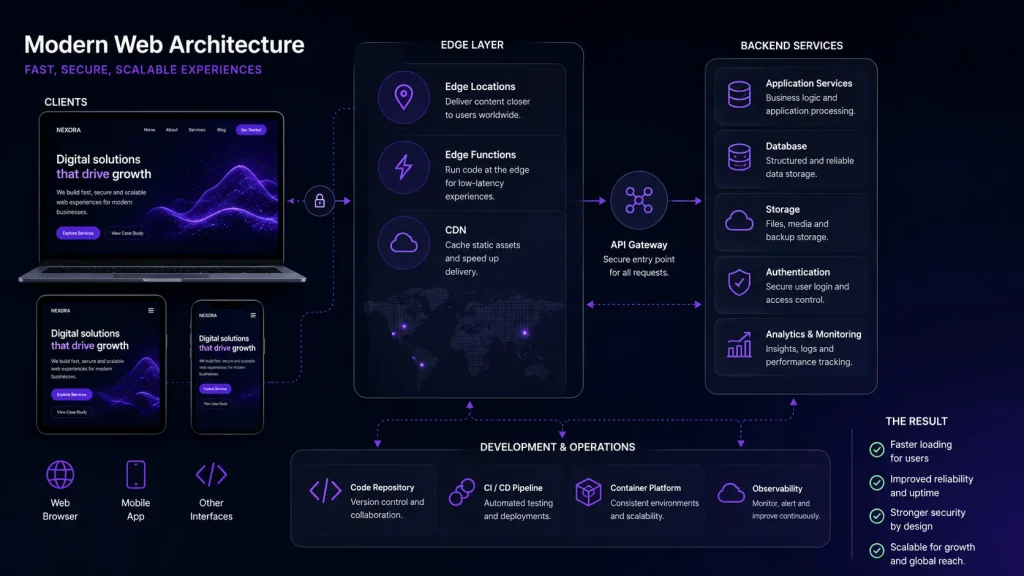
4. Edge Computing Moves Processing Closer to Users
Traditional websites often process requests from one central server or data centre.
Edge computing distributes certain workloads closer to users.
Imagine a South African website serving customers in Johannesburg, Cape Town, London and Sydney.
If every dynamic request needs to travel to the same distant infrastructure before returning to the user, geography can introduce latency.
Edge infrastructure can perform suitable operations from geographically distributed locations.
The objective is straightforward:
reduce the distance between the user and the work required to produce the response.
Edge computing can be useful for applications with geographically distributed audiences, dynamic personalisation or latency-sensitive functionality.
However, not every business website needs an elaborate edge architecture.
A well-built local business website may gain far more from efficient code, optimised images, good hosting and caching.
Architecture should match the problem.
5. Performance Becomes a Development Requirement
Website performance should no longer be treated as something developers fix just before launch.
Performance decisions begin much earlier.
Framework choice, hosting, JavaScript, third-party scripts, fonts, database queries, images and architectural decisions can all affect how quickly a website responds.
That makes performance part of development itself.
A technically impressive website that feels slow on a customer’s phone is still providing a poor experience.
This is particularly relevant when building for audiences who may use different devices and network conditions.
Performance-focused development can include techniques such as:
- Efficient image delivery
- Caching
- Code splitting
- Reducing unnecessary JavaScript
- Optimising database operations
- Efficient font loading
- Content delivery networks
- Monitoring Core Web Vitals
The objective is not simply achieving an impressive test score.
It is making the website feel fast to real users.
6. Baseline-First Web Development
One of the most useful developments for web developers is not a new framework.
It is better clarity around browser compatibility.
Web Platform Baseline helps developers understand when web platform features are supported across core browsers.
This matters because developers have historically needed to determine whether a modern CSS or JavaScript feature could safely be used across different browsers.
In 2026, Baseline continues to expand with useful capabilities including container style queries, contrast-color(), CSS shape(), active View Transitions, Trusted Types, WebTransport and the Navigation API.
This allows developers to make more informed decisions about using modern browser features.
The broader trend is important:
modern web development is increasingly able to rely on the web platform itself.
That can sometimes reduce the need for additional JavaScript libraries or complicated workarounds.
7. Native Browser APIs Become More Powerful
Modern browsers can do significantly more than render documents.
One useful example in 2026 is the Navigation API.
Single-page applications have traditionally needed to work around limitations in browser history handling. The Navigation API provides developers with a more purpose-built approach to client-side navigation.
It can also work alongside View Transitions to create smoother application-like transitions between interface states.
This reflects a broader change.
Functionality that once required custom solutions or third-party libraries is gradually becoming part of the browser platform.
For developers, native capabilities can offer benefits such as improved interoperability and fewer dependencies.
For users, the result can be websites that feel more fluid without requiring excessive complexity.
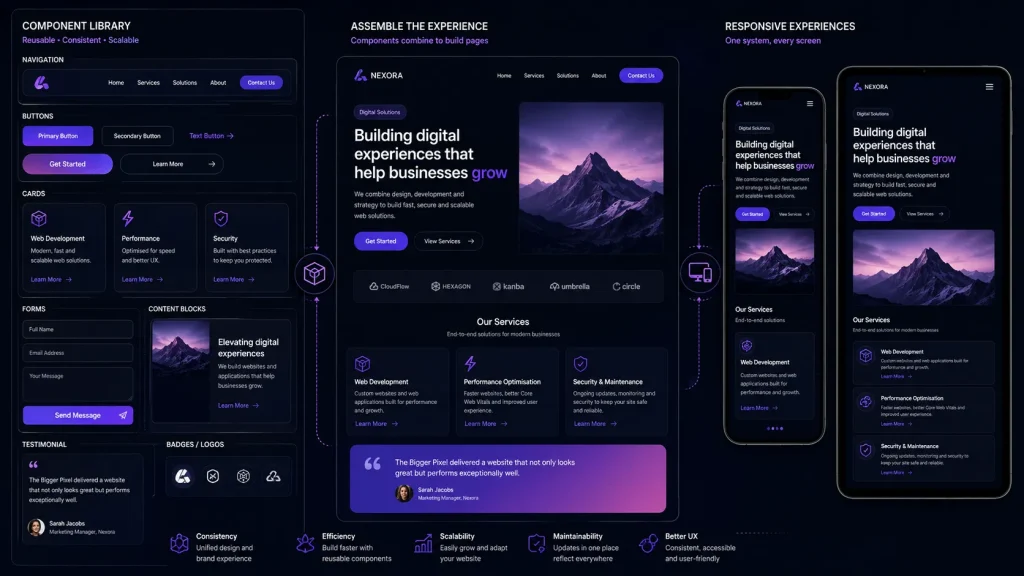
8. Component-Based Development Continues to Grow
Modern websites are rarely collections of completely unrelated pages.
They are systems.
Navigation, buttons, forms, product cards, testimonials, calls to action and content sections often appear repeatedly.
Component-based development turns these patterns into reusable building blocks.
Instead of rebuilding the same element every time it appears, developers create a component that follows established design and behaviour rules.
This can improve consistency and make future development easier.
For businesses, component-based systems are particularly useful as websites grow.
A company might start with ten pages and later introduce new services, locations, campaigns or products.
Reusable components make that expansion more manageable.
The result is not only cleaner code.
It is a website that can evolve more efficiently.
9. API-First and Headless Architecture
Another important web development trend is the continued growth of API-first and headless architectures.
In a traditional website, content management and the visible frontend are often tightly connected.
A headless approach separates them.
Content can be managed in one system and delivered through an API to a website, mobile application, digital display or another interface.
This can be powerful for organisations that need to distribute the same information across several channels.
For example, a retailer could maintain product information centrally while displaying it across a website and other digital experiences.
However, headless architecture also introduces complexity.
Businesses should not choose it simply because it sounds modern.
For many SMEs, a conventional WordPress implementation can be easier to manage and entirely capable of meeting their requirements.
Headless architecture becomes valuable when the business problem genuinely benefits from that separation.
10. Security by Design
As development workflows become faster, security needs to become more deliberate.
Web applications depend on interconnected systems: packages, APIs, authentication services, databases, plugins, frameworks and third-party integrations.
Every dependency potentially expands the area developers need to protect.
Security therefore needs consideration throughout development rather than being reduced to installing a security plugin after launch.
Good practices can include keeping dependencies updated, validating input, controlling permissions, protecting authentication, managing secrets correctly and reducing unnecessary software.
Modern browser capabilities are also evolving in this area. Trusted Types and CSP reporting capabilities are among the technologies included in the developing Baseline 2026 feature set.
For businesses, the important principle is straightforward:
website security is an ongoing engineering responsibility, not a one-time feature.
11. Accessibility Moves Into the Development Workflow
Accessibility is both a design and development responsibility.
A designer may specify sufficient colour contrast and readable typography, but developers determine whether interactive elements work correctly with keyboards, whether semantic HTML is used appropriately and whether dynamic interfaces communicate their state.
That means accessibility should be considered while components are being developed.
Common considerations include:
- Semantic HTML
- Keyboard navigation
- Visible focus states
- Form labels and instructions
- Alternative text support
- Logical heading structures
- Accessible interactive components
- Appropriate ARIA implementation when necessary
Building these considerations into components from the beginning is usually more efficient than trying to retrofit them throughout a completed website.
Accessibility is therefore increasingly part of what quality development means.
12. Web Development Becomes More Business-Focused
Perhaps the most useful web development trend in 2026 is a change in mindset.
Businesses do not need technologies.
They need outcomes.
A company does not need an API-first architecture simply because API-first development is popular.
It may need a system that allows product information to be shared across three customer platforms.
A business does not need AI because competitors are discussing AI.
It may need automation that reduces repetitive support enquiries.
Likewise, it does not necessarily need the newest JavaScript framework.
It may need a fast, reliable website that employees can update without calling a developer every time a paragraph changes.
Technology selection should follow business requirements.
This becomes increasingly important as AI makes it easier to generate technically sophisticated systems.
The ability to build something does not automatically make it worth building.
Which Web Development Trends Should Businesses Actually Adopt?
Businesses considering a new website or digital platform in 2026 should evaluate technology through five questions:
- Does it solve a genuine customer or business problem?
- Will it improve performance, usability or efficiency?
- Can the solution be maintained over the long term?
- Does the additional complexity justify its cost?
- Can it evolve as the business grows?
For many South African SMEs, the right technology stack may be less exotic than trend reports suggest.
A fast, secure and responsive website with reliable hosting, strong technical SEO and an easy-to-manage CMS may provide significantly more business value than an unnecessarily complicated architecture.
Larger digital products may genuinely benefit from edge infrastructure, API-first architecture, server-first frameworks and sophisticated AI integration.
The technology should fit the organisation rather than forcing the organisation to fit the technology.
Frequently Asked Questions About Web Development Trends 2026
What are the biggest web development trends in 2026?
Major web development trends in 2026 include AI-assisted coding, agentic development workflows, server-first architectures, edge computing, performance-focused development, modern browser APIs, component-based development, API-first architecture, security and accessibility.
How is AI changing web development?
AI can help developers generate code, analyse existing systems, create tests and automate repetitive development tasks. More advanced agentic workflows can handle broader tasks, although developers still need to review output for accuracy, security and maintainability.
Will AI replace web developers?
AI is changing the tasks developers perform, but modern web projects still require architecture, problem solving, security decisions, testing, business understanding and quality control. AI-generated code also requires appropriate review.
Is WordPress still relevant in 2026?
Yes. WordPress can remain a practical option for businesses that need flexible content management, marketing websites, publishing and eCommerce. Whether it is appropriate depends on the project’s requirements rather than the age of the platform.
What is edge computing in web development?
Edge computing places certain processing and services geographically closer to users rather than relying entirely on a central server. This can reduce latency for appropriate workloads, particularly for applications serving geographically distributed audiences.
What is server-first web development?
Server-first development performs more rendering and data processing on the server instead of requiring the user’s browser to handle everything. The objective can include reducing client-side JavaScript and improving initial performance while retaining client-side interactivity where needed.
What is headless web development?
Headless architecture separates the content or backend system from the frontend interface. The backend exposes content or functionality through APIs, allowing it to be consumed by websites, applications and potentially other digital channels.
What web development technology should a small business use?
There is no universal technology stack for small businesses. The best choice depends on functionality, budget, content requirements, integrations, expected traffic and future plans. In many cases, simplicity and maintainability are more valuable than adopting the newest framework.
Conclusion
The biggest web development trends of 2026 show an industry becoming faster, more intelligent and increasingly capable.
AI is transforming development workflows. Server-first and edge architectures are changing where applications perform their work. Native browser APIs are becoming more capable, while Baseline makes cross-browser support easier to evaluate.
At the same time, performance, accessibility and security are becoming fundamental development requirements.
For businesses, however, the most important trend is not a particular framework, API or AI tool.
It is purposeful technology selection.
The best web development approach is not necessarily the newest one. It is the one that produces a fast, secure and maintainable digital platform that solves the right problem and can continue supporting the business as it grows.
Sources
- Baseline: know which web features work everywhere today — Google
- Navigation API — MDN Web Docs
- View Transitions API — Chrome for Developers
- Container queries and container style queries — Chrome for Developers
- Trusted Types API — Google
- WebTransport API — MDN Web Docs