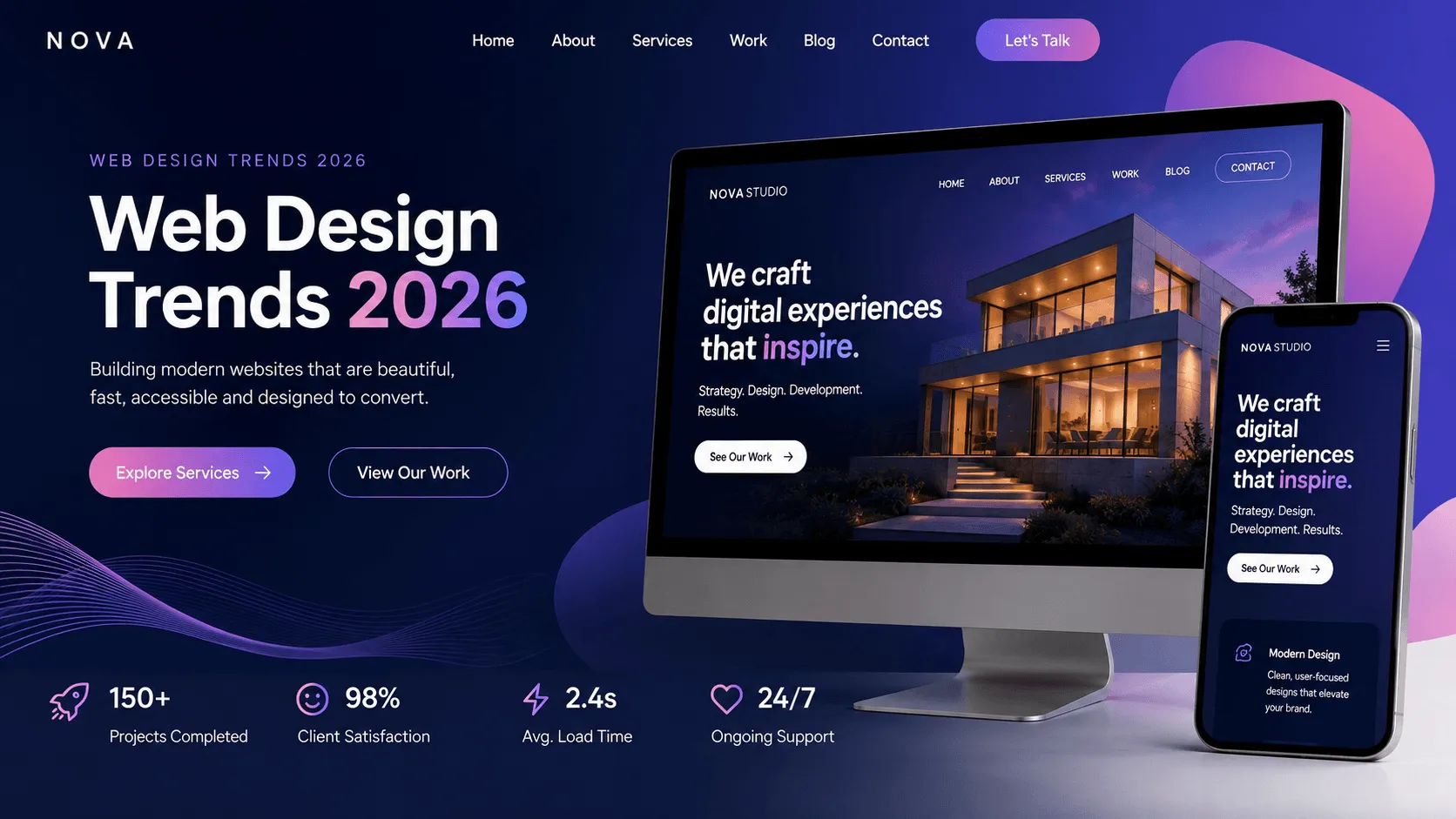
Web design trends in 2026 are moving beyond aesthetics. The strongest websites combine distinctive visual identities with speed, accessibility, mobile usability and experiences designed around what visitors actually need to accomplish.
AI is also changing how websites are planned and created, while advances in CSS and browser technology are giving designers and developers more options for building sophisticated experiences without sacrificing usability.
For businesses, this creates an important distinction: a website can look current without necessarily performing well.
The best web design trends are therefore not the ones you copy simply because they are popular. They are the ideas that strengthen your brand, improve the customer experience and help your website achieve a measurable business purpose.
Here are 15 web design trends shaping modern websites in 2026.
What Is Shaping Web Design in 2026?
Website expectations have changed.
Visitors move between phones, laptops and tablets throughout the day. They expect pages to load quickly, navigation to make sense immediately and information to be easy to find.
At the same time, businesses are competing in increasingly crowded digital markets. A generic website assembled from the same templates, layouts and stock imagery as everyone else can struggle to communicate why a brand is different.
This is pushing web design in two directions at once.
Websites need more personality, but they also need less friction.
That balance between creativity and usability defines many of the biggest web design trends of 2026.
1. AI-Assisted Web Design
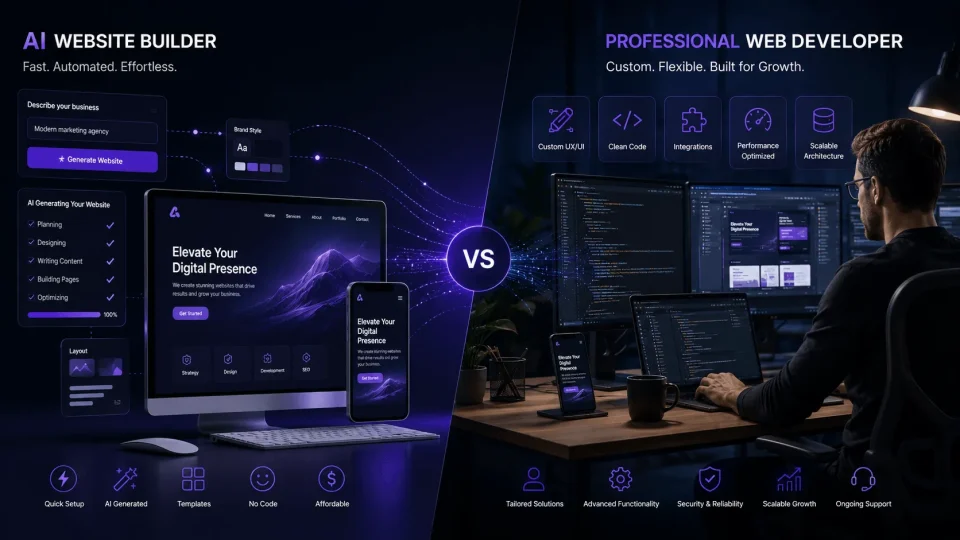
Artificial intelligence is becoming part of the web design workflow rather than simply being a feature added to websites.
Designers and developers can use AI-assisted tools during research, ideation, prototyping, content planning and development. This can accelerate parts of the creative process, but speed does not remove the need for human judgement.
A generated interface may technically work while still failing to understand a company’s positioning, customers or conversion journey.
The more interesting trend for businesses is therefore not fully automated web design. It is AI-assisted design combined with human strategy.
AI can help teams explore ideas faster, while experienced designers determine which ideas actually support the brand and user.
That distinction will become increasingly important as AI-generated websites become easier to produce.
2. Purposeful Minimalism
Minimalism is not disappearing in 2026. It is becoming more purposeful.
Modern minimalist websites often use generous spacing, clear navigation, carefully selected imagery and fewer competing elements. The objective is not simply to make the website look clean.
It is to make decisions easier.
When visitors arrive on a page, they should quickly understand:
- Who the business is
- What it offers
- Why the offer matters
- What they should do next
Removing unnecessary visual noise helps important information stand out.
For businesses, this can be especially effective on service pages, landing pages and product experiences where every additional distraction competes with the primary call to action.
3. Bold, Expressive Typography
Typography is increasingly becoming part of a brand’s visual identity rather than simply a container for text.
Large headlines, unusual type combinations and expressive typography can give a website personality before a visitor has processed the message itself.
The key word, however, is controlled.
Large text still needs to work across different screen sizes. Fonts should remain readable, and visual impact should never make important information difficult to understand.
A successful typography system combines personality with hierarchy.
Visitors should be able to scan a page and immediately distinguish the main message, supporting information and actions available to them.
4. Micro-Interactions and Meaningful Motion
Animation continues to play an important role in modern web design, but excessive movement can quickly become distracting.
In 2026, effective motion is increasingly about feedback and context.
A button can respond when someone interacts with it. A menu can transition smoothly between states. Content can reveal itself as visitors progress through a page.
These small interactions can make a digital interface feel more responsive.
The important question is not, “Can we animate this?”
It is, “Does the animation help the user?”
Motion should support navigation, hierarchy or storytelling. If it delays visitors from accessing information or makes a website harder to use, it has become decoration rather than experience design.
5. More Immersive Scrolling Experiences
Scrolling has evolved from simply moving down a page.
Brands are experimenting with layered imagery, controlled transitions, horizontal elements, sticky content and narrative sequences that change as users move through an experience.
This can be particularly effective for portfolios, hospitality businesses, property developments, product launches and brands where visual storytelling influences the buying decision.
But immersive does not need to mean complicated.
The most successful scrolling experiences still allow users to understand where they are and how to reach the information they need.
A visually impressive experience that hides basic information is unlikely to serve the business well.
6. Accessibility-First Design
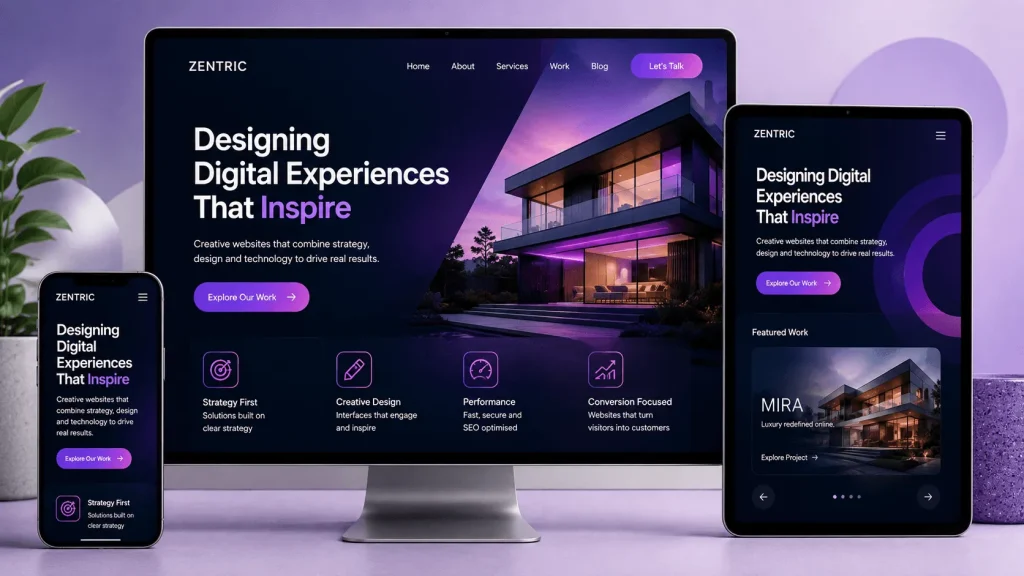
Accessibility is increasingly becoming a fundamental part of good web design.
That means considering colour contrast, typography, keyboard navigation, meaningful labels, focus states, alternative text and understandable page structures during the design process rather than attempting to fix accessibility issues after launch.
Accessibility also overlaps with usability.
Clearer interfaces, readable content and predictable navigation can benefit a much broader audience than any single accessibility requirement.
For South African businesses serving diverse audiences across different devices and environments, inclusive design should be viewed as part of creating a better digital experience.
A modern-looking website that some visitors struggle to use is not genuinely well designed.
7. Performance-Led Design
One of the most important web design trends in 2026 is barely visible.
It is performance.
High-resolution media, elaborate animation, custom fonts and third-party scripts can all contribute to an attractive website. They can also create a slow one when implemented carelessly.
This means designers and developers need to think about performance together.
Images should be appropriately sized and compressed. Fonts need to be managed carefully. Animations should be purposeful. Code and third-party integrations need to justify their impact.
Performance is therefore becoming a design constraint rather than a development problem.
The Bigger Pixel’s PageSpeed optimisation service focuses on areas such as image optimisation, caching, code delivery and Core Web Vitals.
The lesson is straightforward: visual ambition and website speed should not be competing objectives.
8. Mobile-First Experiences
Mobile-first design is no longer new, but it remains essential.
The difference is that modern mobile design needs to consider much more than shrinking a desktop layout.
Navigation, buttons, forms, typography, imagery and content hierarchy all need to work naturally on smaller touchscreens.
Mobile users may also have different priorities.
Someone visiting a restaurant website from their phone may want directions or a reservation immediately. A potential customer visiting a service business may want to call, send an enquiry or check opening information without navigating through several pages.
Effective responsive design therefore considers intent as well as screen size.
9. Conversion-Focused UX
A beautiful website does not automatically produce enquiries or sales.
That is why conversion-focused UX continues to influence web design in 2026.
Instead of beginning with individual pages, designers increasingly need to consider journeys.
Where does the visitor arrive? What information do they need next? What objections could prevent them from taking action? Where should a call to action appear?
For a service business, that journey might look like:
Landing page → service information → proof → enquiry
For eCommerce:
Product discovery → product evaluation → cart → checkout
Design should make these journeys easier rather than forcing users to work them out.
10. More Organic Layouts and Shapes
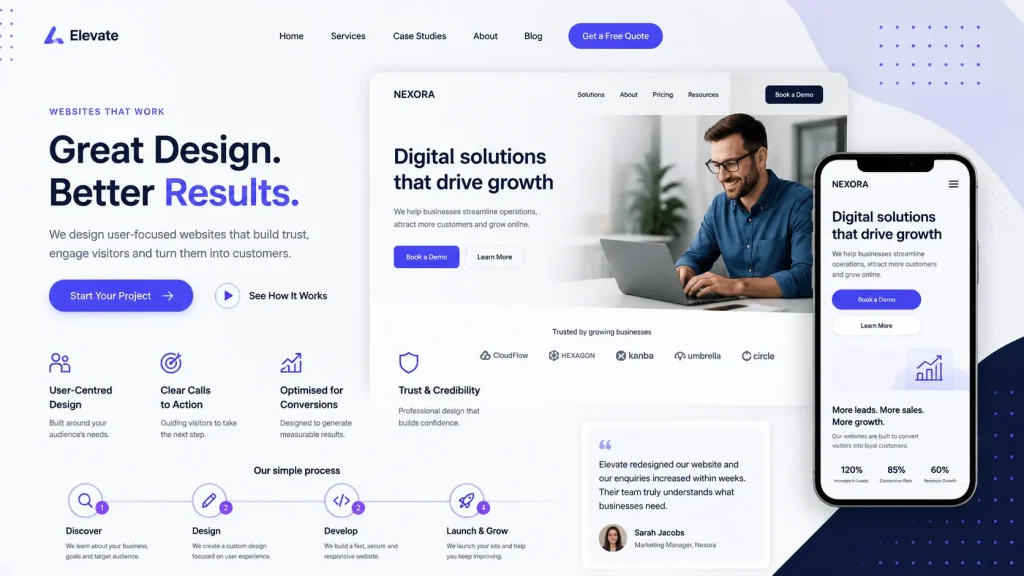
The traditional rectangular grid is becoming more flexible.
Designers can increasingly combine structured layouts with overlapping sections, curved shapes, unconventional image treatments and asymmetrical compositions.
Modern CSS capabilities are helping make these ideas more practical for responsive websites.
The goal should not be randomness.
Strong unconventional layouts still rely on visual hierarchy. Visitors need clear relationships between headings, content, imagery and actions.
Used carefully, organic layouts can help brands escape the familiar template-driven appearance of many websites.
11. Stronger Brand Personality
As automated tools make basic websites easier to create, distinctiveness becomes more valuable.
Businesses increasingly need websites that actually feel like their brand.
That can come from typography, photography, illustration, animation, language, colour, layout or custom interactions.
This is particularly relevant in competitive sectors where several businesses offer similar services.
If five competitors use similar layouts, stock imagery and generic messaging, the company with a coherent visual identity has a better chance of being remembered.
Custom design is therefore becoming less about decoration and more about differentiation.
The Bigger Pixel’s custom WordPress website design approach, for example, builds design around a company’s brand rather than relying on a one-size-fits-all template.
12. Dark and High-Contrast Interfaces
Dark interfaces remain relevant, but the broader trend is toward deliberate contrast.
Dark backgrounds can create a premium or immersive aesthetic, particularly for entertainment, technology, hospitality and creative brands.
They are not automatically appropriate for every website.
Readability, colour contrast, imagery and brand positioning all need consideration.
Some businesses may benefit from primarily light interfaces with strategically placed dark sections. Others may use a dark visual identity throughout.
The choice should follow the brand and user experience rather than the trend itself.
13. Modular and Component-Based Design
Modern websites need to change.
A company might launch new services, add locations, introduce campaigns or expand into eCommerce. Building every page as a completely independent design makes those changes harder to manage.
Component-based design solves part of this problem.
Reusable sections and interface components can create consistency while giving content teams flexibility.
A testimonial component, for example, can maintain the same visual rules wherever it appears. The same applies to calls to action, service cards, product sections and forms.
For WordPress businesses, a well-planned content management system can combine this design consistency with easier day-to-day content management.
14. Smarter Personalisation
Personalisation is moving beyond simply inserting someone’s name into a page.
Web experiences can adapt according to context, previous interactions, customer type, location or stage of the buying journey when businesses have appropriate data and a legitimate reason to use it.
An eCommerce website might surface relevant categories. A multi-location company could make location information easier to reach. Returning users might see content relevant to their previous activity.
But personalisation should solve a user problem.
Collecting unnecessary information or creating an unpredictable experience can undermine trust.
The best personalisation often feels invisible: the website simply becomes more relevant.
15. Design and Development Are Converging
One of the biggest changes behind web design trends in 2026 is happening in the underlying web platform.
Modern browser capabilities are giving developers increasingly sophisticated tools for responsive layouts, transitions, interactions and interface behaviour.
For example, Web Platform Baseline tracks when features achieve support across core browsers. Baseline 2026 includes developments such as container style queries, contrast-color(), CSS shape(), active View Transitions and the Navigation API.
For designers, this matters because ideas that previously required complicated workarounds may become more practical to implement.
For businesses, the takeaway is simpler:
Good web design and good web development can no longer be treated as separate disciplines.
An ambitious interface needs developers who understand how to make it responsive, accessible and performant. Strong development also needs design thinking to ensure technical capabilities produce a useful experience.
Which Web Design Trends Should Your Business Use?
Not every trend belongs on every website.
Before adopting a web design trend, ask four questions:
- Does it strengthen our brand?
- Does it make the website easier to use?
- Does it support a business objective?
- Can it be implemented without compromising accessibility or performance?
If the answer is no, the trend may not be worth implementing.
A professional services website may benefit far more from improved navigation, typography and conversion paths than an elaborate 3D experience.
A hospitality brand, on the other hand, may gain significant value from immersive photography, transitions and storytelling.
The goal is not to build the trendiest website of 2026.
It is to create a website that feels current because it serves today’s users well.
Frequently Asked Questions About Web Design Trends 2026
What are the biggest web design trends in 2026?
Major web design trends in 2026 include AI-assisted workflows, bold typography, purposeful minimalism, micro-interactions, immersive scrolling, accessibility-first design, performance-focused experiences, mobile-first UX, modular design and stronger brand identities.
Is minimalism still a web design trend in 2026?
Yes, but minimalism is becoming more purposeful. Modern minimalist websites focus on reducing distractions, improving hierarchy and helping users reach important information or actions quickly.
How is AI changing web design?
AI can assist with research, ideation, content, prototyping and development. However, human strategy remains important for understanding brand positioning, customer needs, accessibility and business objectives.
Are animations good for website design?
Animations can improve a website when they provide feedback, establish hierarchy or support storytelling. Excessive animation can negatively affect usability and performance, so motion should always have a clear purpose.
Why is accessibility important in modern web design?
Accessibility helps make websites usable by people with different abilities and methods of interacting with the web. Many accessibility practices, including readable text, sufficient contrast and clear navigation, also improve general usability.
Does website speed affect web design?
Yes. Design decisions involving images, video, fonts, scripts and animation can affect performance. Designers and developers should therefore consider performance throughout a project instead of attempting to optimise it only after the website is complete.
Should South African businesses follow international web design trends?
International trends can provide useful inspiration, but South African businesses should evaluate them against their own customers, brand, connectivity considerations and commercial goals. A locally relevant and easy-to-use experience matters more than following every global trend.
How often should a business redesign its website?
There is no universal redesign schedule. Businesses should consider a redesign when their website no longer represents the brand, performs poorly, creates usability problems, cannot support required functionality or no longer meets business objectives.
Conclusion
The most important web design trends of 2026 point toward a web that is simultaneously more expressive and more user-focused.
AI is accelerating creative workflows. Typography and custom visual systems are giving brands more personality. Modern CSS and browser capabilities are opening new creative possibilities. At the same time, accessibility, mobile usability, performance and conversion-focused UX are putting practical outcomes at the centre of design.
Businesses should not respond by adding every new effect to their websites.
The better approach is to identify which ideas improve the experience for their customers and support the goals of the business.
Because ultimately, the best website in 2026 will not be the one that follows the most trends.
It will be the one where design, technology and business strategy work together.