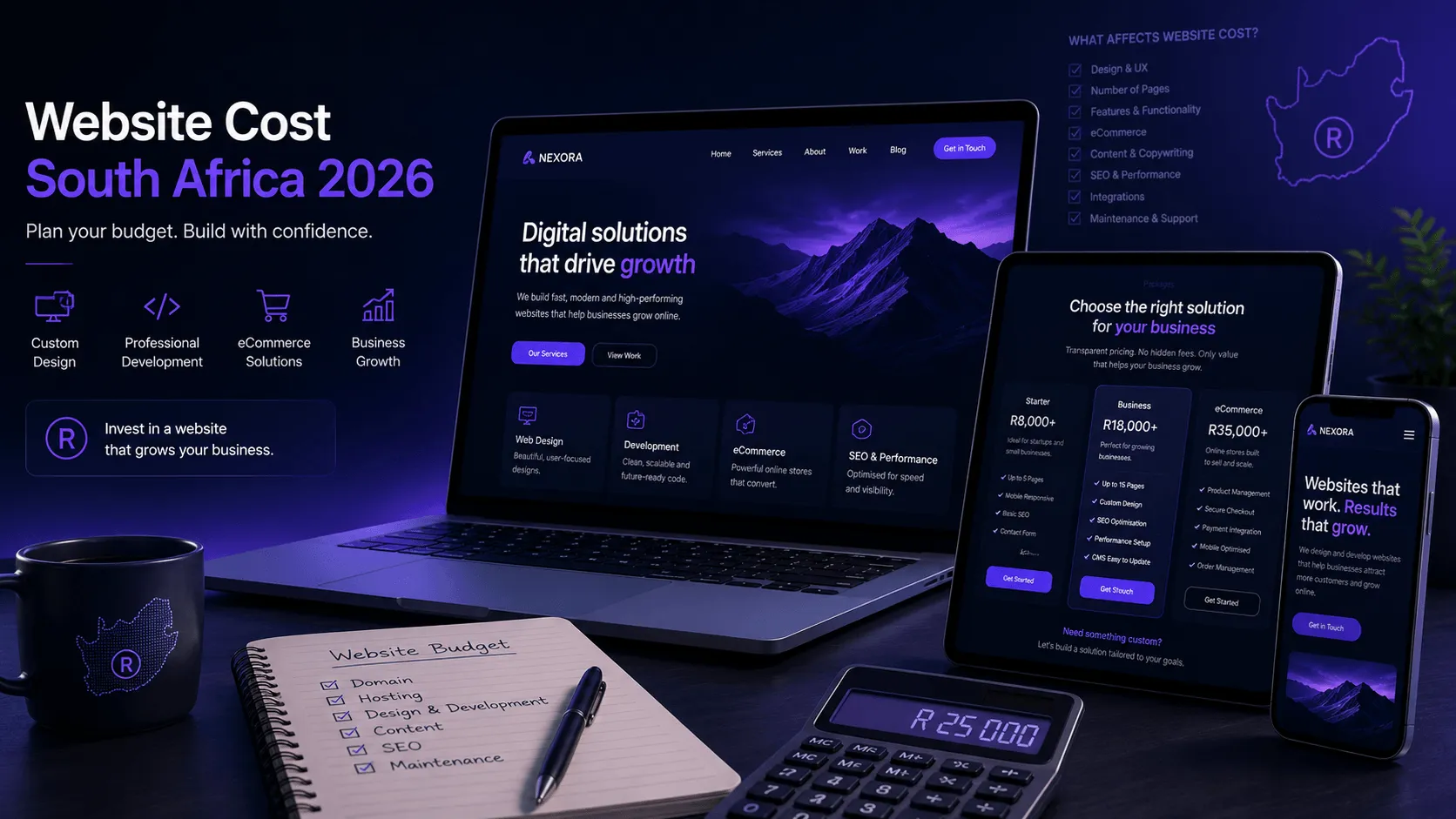
The cost of a website in South Africa in 2026 can range from a few thousand rand for a basic template-based site to R100,000 or considerably more for sophisticated eCommerce platforms, custom websites and web applications.
That range is enormous because “a website” is not a standard product. A five-page informational website for a local business has very different requirements from an online store processing hundreds of products, payments and deliveries. Likewise, adapting a pre-built template requires less work than researching, designing and developing a custom digital experience.
Understanding what influences website pricing is therefore more useful than searching for one average price. This guide explains what South African businesses can expect to pay in 2026, why quotes vary and what to consider before choosing a web design company.
Website Costs in South Africa: Quick Answer
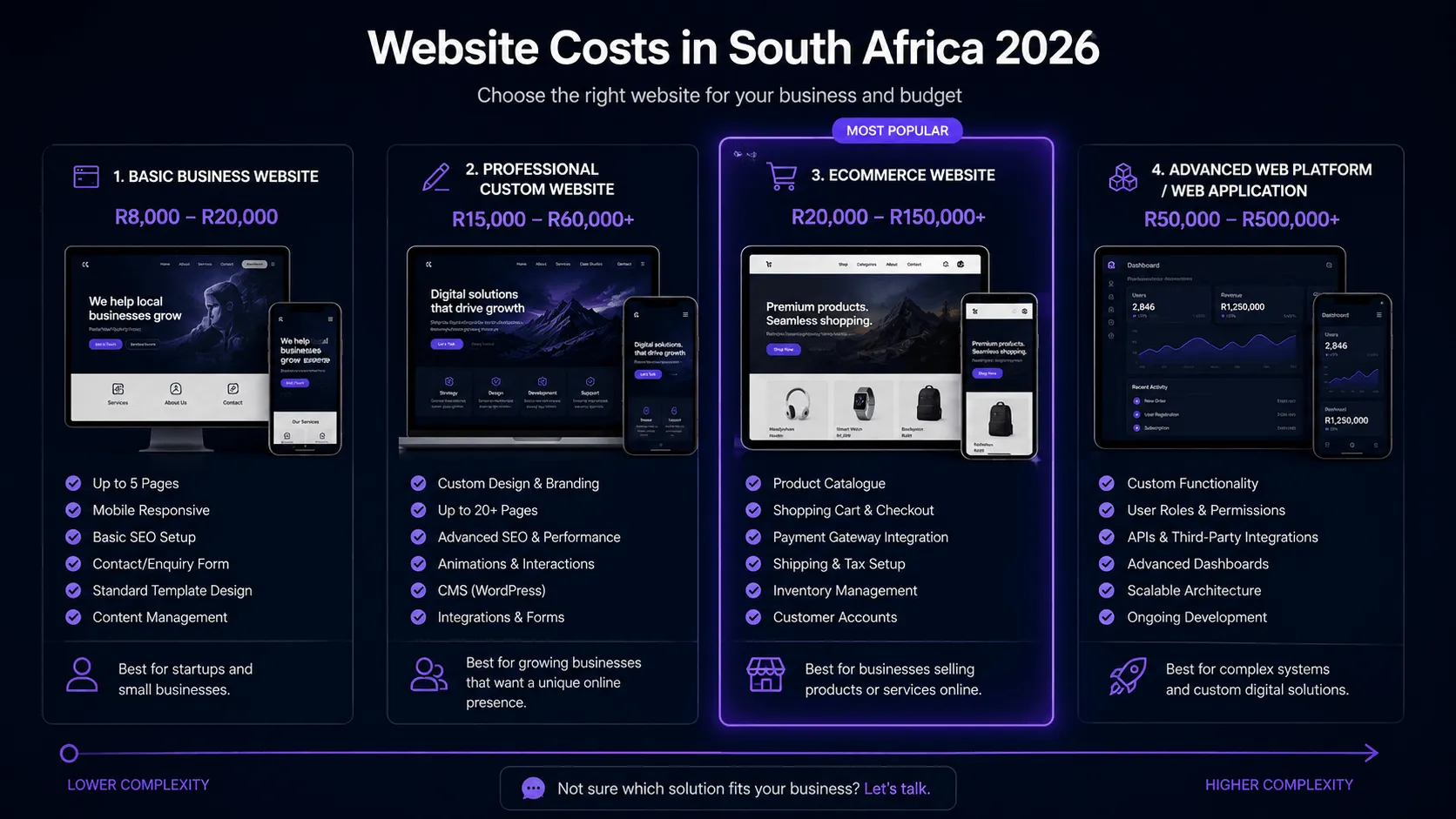
Recent South African pricing guides illustrate just how broad the market is. Professional small-business websites are commonly advertised from roughly R5,000 into the R30,000+ range, while more customised agency projects can move significantly higher. eCommerce websites have an even wider range, with current published guides spanning tens of thousands to R150,000 or more depending on complexity.
These figures should be treated as market indicators, not fixed rates. A useful way to think about the market is:
| Website Type | Indicative 2026 Market Range |
|---|---|
| DIY/template website | R0–R8,000 |
| Basic professional business website | R8,000–R20,000 |
| Custom SME/business website | R15,000–R40,000+ |
| Advanced custom website | R30,000–R100,000+ |
| eCommerce website | R20,000–R150,000+ |
| Bespoke web application | R50,000–R500,000+ |
These ranges overlap deliberately. A six-page website with custom animation, professional copywriting and API integrations could cost considerably more than a 15-page website built from reusable templates. The scope matters more than the page count alone.
Website Pricing by Type
Basic Business Website
A basic business website typically provides the information customers need to understand a company and make contact. It might include a home page, about page, services, contact page, enquiry form, mobile-responsive layouts, basic search optimisation and content management.
For straightforward requirements, published South African prices often fall somewhere around R8,000–R20,000, although cheaper and more expensive options exist. The important distinction is what “basic” includes. One provider might adapt an existing template. Another might include discovery, custom layouts, SEO foundations, performance optimisation and post-launch support. Those are not equivalent products.
Custom Business Website
A custom website is designed around a company’s brand, audience and objectives instead of simply inserting content into a generic layout. Projects may include UX planning, custom interface design, responsive layouts, custom WordPress development, conversion planning, advanced forms, animation, SEO foundations, performance optimisation, analytics and third-party integrations.
Current South African market guides commonly place professional custom business websites somewhere in the R15,000–R60,000+ territory, depending heavily on scope. Larger agency projects can exceed this substantially. Customisation increases the initial investment, but it can be justified when the website plays an important role in lead generation, brand positioning or customer acquisition. See our custom WordPress website design service for examples.
eCommerce Website
An online store introduces considerably more functionality than a standard informational website. The website may need to manage products, categories, inventory, customer accounts, shopping carts, checkout, payments, delivery rules, promotional codes, transactional emails, order management, product filtering, analytics and accounting or ERP integrations.
This explains why eCommerce website costs in South Africa vary so widely. Current 2026 South African guides quote ranges from around R20,000 for simpler professional stores to R150,000+ for advanced builds. Complex custom commerce platforms can go substantially beyond this. The number of products matters, but integrations and operational complexity can matter even more. A store selling 20 highly configurable products may require more development than one selling 500 straightforward products.
Custom Web Applications
A web application goes beyond displaying content. It may allow users to perform specialised tasks such as managing accounts, generating quotations, booking services, processing data, accessing dashboards or interacting with proprietary business systems. At this point, pricing becomes difficult to estimate without detailed requirements.
A custom application might require user authentication, permissions, database architecture, APIs, business logic, dashboards, automated processes, third-party systems, testing, security engineering and ongoing development. Budgets can range from tens of thousands of rand to hundreds of thousands. For these projects, asking “How much does a website cost?” is similar to asking “How much does software cost?” — the requirements determine the answer.
Why Website Prices Vary So Much
Two agencies can quote very different prices for something described as a “10-page WordPress website.” That does not automatically mean one is overpriced. They may be proposing completely different processes.
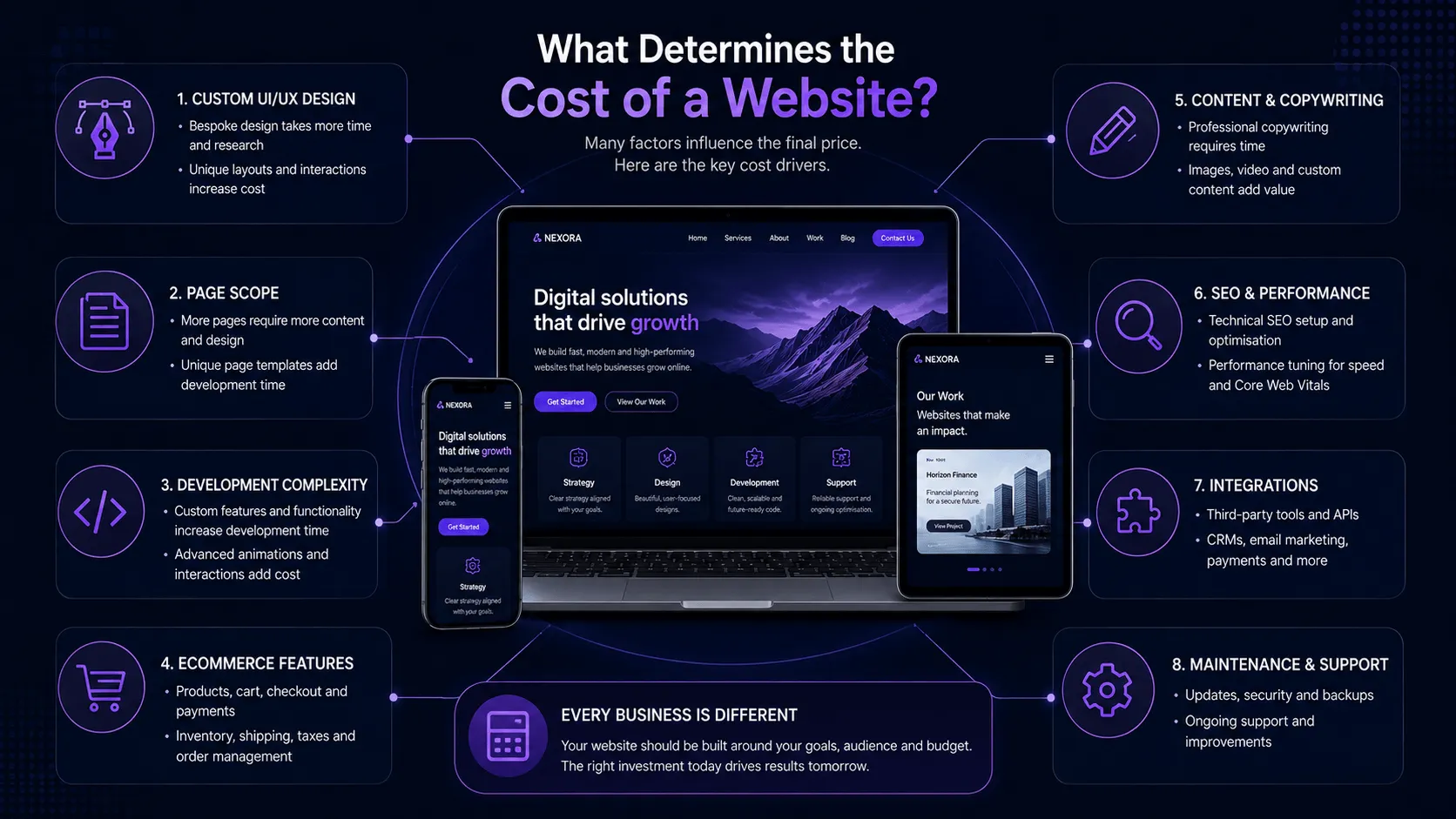
One quote might include a pre-built theme and supplied content. Another could include customer research, information architecture, wireframes, custom UI design, development, copywriting, technical SEO, performance optimisation, testing and post-launch support. To compare prices properly, businesses need to compare scope rather than totals. Here are the main factors affecting website development costs.
1. Custom Design vs Templates
Templates reduce design and development time. That makes them useful when budget and speed matter more than uniqueness. Custom design starts from the requirements of the brand and audience. Designers can determine the hierarchy, layout, calls to action, typography, visual system and responsive behaviour instead of adapting decisions made for another website.
Neither approach is automatically correct. A startup validating an idea may be perfectly well served by a carefully configured template. An established company repositioning its brand may need something more distinctive. The mistake is paying custom-design prices for what is essentially an unchanged template.
2. Number and Complexity of Pages
More pages generally mean more work, but page count alone is a poor pricing measure. Consider two projects. Website A has 20 pages built using four reusable layouts. Website B has eight pages, but each contains custom layouts, interactive tools, animations and unique functionality. Website B could require considerably more work.
When evaluating a proposal, look beyond the number of pages and ask how many unique templates and components need to be designed and developed.
3. Features and Functionality
Functionality is one of the biggest drivers of website development cost. A simple contact form is relatively straightforward. A quotation system that calculates prices based on customer inputs, creates a PDF, stores the enquiry in a CRM and sends different notifications involves substantially more work.
Additional functionality might include booking systems, customer portals, search and filtering, membership, interactive calculators, multilingual functionality, location systems, advanced forms, CRM integrations and custom databases. Every feature should solve a genuine problem. Adding functionality that customers do not need increases both development cost and future maintenance.
4. eCommerce Requirements
eCommerce pricing depends on much more than installing WooCommerce or creating a Shopify account. Businesses need to consider their actual sales process. How many products are there? Are there variants? How is stock managed? Which payment gateway is required? How are shipping costs calculated? Does the website need to connect to accounting, inventory, courier or CRM software? Does the company sell to consumers, businesses or both?
These requirements determine the complexity of the store. This is why two eCommerce quotations can differ by tens of thousands of rand even when both proposals say “online shop.”
5. Content and Copywriting
A website still needs something to say. Some quotations assume the client will provide every word, photograph, product description and downloadable document in a finished format. Others include content strategy or copywriting. Professional copywriting can add to the project budget, but it can also solve one of the most common website problems: an attractive interface filled with vague messaging.
Before comparing quotes, establish who is responsible for page copy, headlines, calls to action, photography, product information, case studies, team information and legal content. Content delays can easily become development delays.
6. SEO and Performance
“SEO included” can mean almost anything. At a basic level, a website might include editable titles, meta descriptions, sensible heading structures and search-friendly URLs. A more substantial SEO implementation might involve keyword research, redirects, structured data, internal-link planning, content optimisation and technical audits.
Performance is similar. Compressing a few images is different from engineering a website around Core Web Vitals, efficient code delivery, caching and carefully managed third-party scripts. Businesses should ask providers to explain exactly what SEO and performance optimisation mean within their proposal. Our PageSpeed optimisation service is one example of what deeper performance work looks like.
7. Integrations
Modern websites rarely operate alone. They may connect with CRM platforms, email marketing tools, payment gateways, accounting software, courier services, inventory platforms, booking systems, analytics and external APIs. Some integrations are simple. Others require custom development, authentication, data transformation, testing and ongoing monitoring. Integrations can therefore have a significant effect on website development cost.
Once-Off vs Ongoing Website Costs
The build price is not the full cost of owning a website. Businesses should also budget for ongoing expenses. These may include domain registration (your web address generally renews annually), hosting (infrastructure on which the website operates), maintenance (software, plugins and dependencies may require updates and monitoring), security (depending on the project, ongoing security services may be appropriate), premium software (some themes, plugins, applications or services charge recurring licence fees), support (businesses may require a developer for changes and troubleshooting), and content and SEO (websites intended to generate organic search traffic generally need ongoing content and optimisation rather than a once-off setup).
An inexpensive website with expensive subscriptions and frequent maintenance can have a higher long-term cost than its initial quote suggests. Businesses should therefore evaluate total cost of ownership, not only the launch price.
Cheap vs Professional Websites
A cheap website is not automatically bad. Likewise, an expensive website is not automatically good. Price becomes meaningful only in relation to what the business needs. A R5,000 website could be entirely appropriate for a new solo business that needs a simple online presence. The same website might be a poor investment for an established company relying on digital enquiries to generate millions of rand in revenue.
| Lower-Cost Approach | Professional Custom Approach |
|---|---|
| Template-led | Brand-led |
| Limited discovery | Strategy and discovery |
| Standard layouts | Custom UX/UI |
| Basic functionality | Requirements-led functionality |
| Client-supplied content | Potential content strategy |
| Basic optimisation | Deeper performance/SEO work |
| Limited support | Structured support options |
| Best for simple needs | Best for business-critical websites |
The question is therefore not “How cheaply can we get a website?” but “What level of website does our business actually need?”
How to Compare Website Quotes
When comparing website quotations, avoid choosing solely from the final number. Ask every provider to clarify whether the design is custom or template-based, how many unique pages or templates are included, who provides the content, what functionality is included, what SEO work is included, whether performance optimisation is included, whether mobile layouts are specifically designed and tested, which third-party licences have recurring costs, who owns the website and its assets after payment, what happens after launch, whether hosting is included and what future changes will cost.
This makes competing proposals much easier to compare. It can also reveal why one quotation costs considerably more than another.
How Much Should Your Business Budget?
Start with the role the website plays in the business. If you simply need an online presence with contact information, the budget can remain relatively modest. If the website is expected to generate leads, communicate a premium brand or support significant marketing investment, allocating more budget to strategy, content, design and development may be justified. If the website directly processes revenue, the business case changes again.
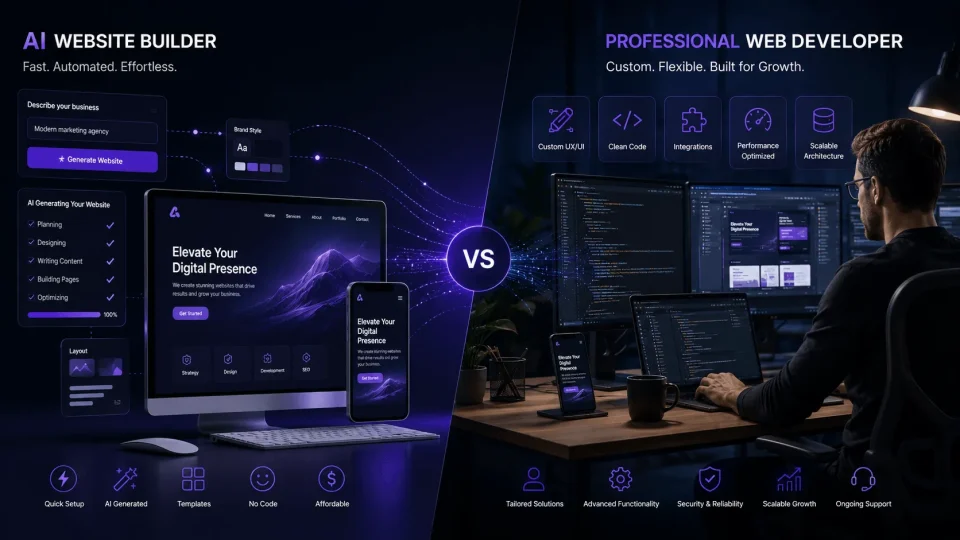
Instead of choosing an arbitrary budget first, define what the website needs to achieve, who needs to use it, which functionality is essential, which systems it must connect with, what content needs creating, how important search visibility is and how the website will be maintained. Then obtain proposals against the same requirements. That produces much more meaningful price comparisons. For a related decision guide, see AI website builders vs web developers.
Frequently Asked Questions
How much does a basic website cost in South Africa?
Published 2026 South African pricing varies substantially, but basic professionally built business websites are commonly advertised in roughly the R8,000–R20,000 range. Template-based options can cost less, while custom design, content and additional functionality increase the price.
How much does a professional website cost in South Africa?
Professional custom business websites can commonly fall between roughly R15,000 and R60,000 or more, depending on design, functionality, content, integrations and the provider. Larger custom agency projects can cost significantly more.
How much does an eCommerce website cost in South Africa?
Current South African guides show professional eCommerce builds ranging from roughly R20,000 to R150,000+, with bespoke platforms potentially costing more. Product complexity, payment gateways, shipping, integrations and custom functionality are major price factors.
Why are some website designers so cheap?
Lower prices can result from templates, smaller scope, lower overheads, automation or less experienced providers. None automatically means poor quality. Businesses should compare what is included rather than assuming price alone indicates quality.
Is WordPress expensive?
WordPress itself is open-source software, but building and operating a professional WordPress website can involve design, development, hosting, maintenance and premium plugins. The relevant figure is the total cost of the website rather than the CMS licence.
Should I pay monthly or once-off for a website?
Both models can work. A once-off project generally separates the initial build from hosting and maintenance, while subscription models spread costs over time. Compare total cost, ownership terms, cancellation conditions and included services before deciding.
How much should a small business spend on a website?
There is no universal amount. A small business should budget according to how important the website is to sales, marketing and operations. A simple informational site requires less investment than a lead-generation platform or online store.
Are hosting and maintenance included in website design prices?
Not always. Some providers include hosting or maintenance for a defined period, while others charge separately. Ask for recurring fees, licence costs, hosting and support to be listed clearly before approving a proposal.
Conclusion
So, how much does a website cost in South Africa in 2026? The realistic answer is that the market stretches from inexpensive DIY and template websites to custom digital platforms costing hundreds of thousands of rand. For many professional SME websites, current published pricing clusters in the tens of thousands of rand rather than producing one reliable “average.” eCommerce, integrations and custom software can increase that investment substantially.
But price alone tells you very little. A website should be evaluated according to its strategy, design, content, functionality, performance, maintainability and the business problem it solves. The best-value website is not necessarily the cheapest or the most expensive. It is the one that provides the right level of investment for the role the website needs to play in your business.